Southeastern Anatolia • Cultural Route
Şanlıurfa and Göbeklitepe: Stories Carved in Stone
A journey that expands time, from a tranquil stroll around Balıklıgöl to the front of one of humanity's oldest monumental structures.
Photograph: Jt mustafa / Wikimedia Commons (CC BY-SA 4.0).
Upon arriving in Şanlıurfa, one shouldn't simply view the trip as a list of places to see. The city's rhythm is felt in the stone buildings standing side-by-side on the same street, in the sounds of the bazaar, and in the courtyards. For a traveler arriving from the Aegean region, the first impression is that the familiar coastal landscape is replaced by warm-colored stone and a wide horizon. This change is the most beautiful aspect of the journey: in a few days, you can approach the daily life of a completely different geography.
A slow start around Balıklıgöl
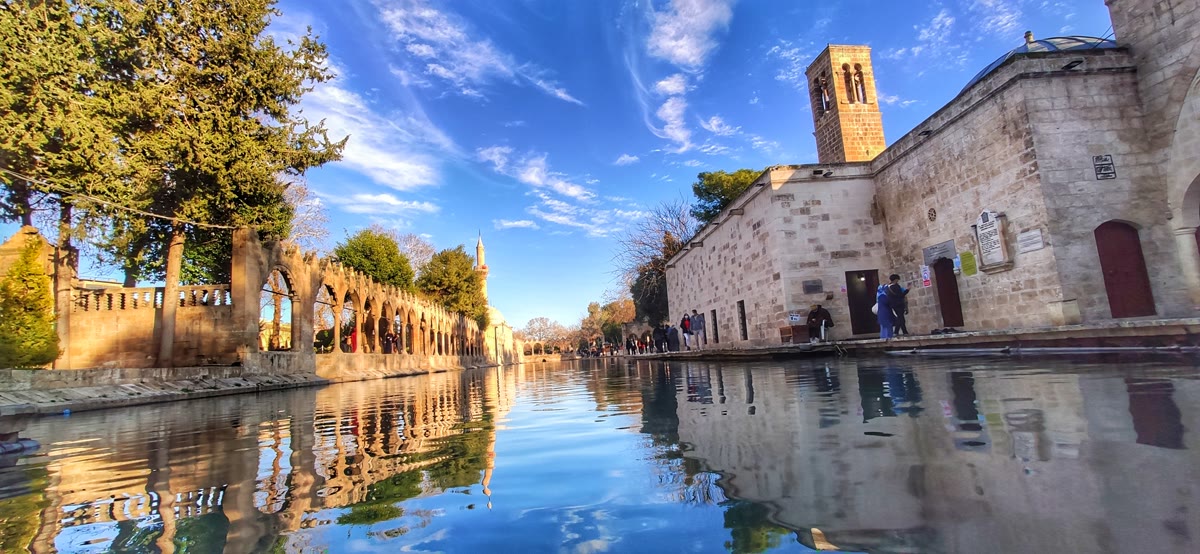
It's a good idea to start exploring the city around Balıklıgöl (Fish Lake). The area, with its water, trees, and historical buildings, offers a peaceful stroll despite being in the city center. Don't just view the lake as a photo opportunity; sit by the shore for a while and observe how people spend their time. While strolling between the Halil-ür Rahman Mosque and Aynzeliha Lake, you'll also notice the place of the region's religious narratives in the city's collective memory. Listening to these narratives as part of the living culture, rather than confusing them with historical evidence, enriches the trip.
The pace changes as you move into the market area. In the small squares that open up from the narrow streets, copperware, textiles, and local products are displayed side by side. You don't have to buy anything; even a short stop in front of a shop shows the connection between craftsmanship and the city's identity. Since it can get crowded in the middle of the day, it might be more comfortable to leave your market walk for the morning or late afternoon. Don't rush to find your way; sometimes the best discovery is in a short street branching off from the main route.
From museum to archaeological site: Understanding Göbeklitepe
Before visiting Göbeklitepe, taking the time to visit the Şanlıurfa Archaeology Museum will make the site more meaningful. Seeing the artifacts from the Neolithic period in the museum helps you understand the stones from the excavation site not just as impressive forms, but as traces of a long history of humanity. Instead of spending equal time on each display case, you can choose a few periods that particularly interest you. This way, what you see at the next stop will be better understood.
Göbeklitepe, added to the UNESCO World Heritage List in 2018, is one of the most significant landmarks in the Şanlıurfa region. UNESCO identifies the monumental structures and T-shaped megaliths bearing animal depictions built by hunter-gatherer communities between 9600 and 8200 BC. This information alone seems impressive; however, the real impact when standing in front of the site is the proliferation of questions about the past. Why did people come together, what meanings did they attribute to the stones, what did they want to make permanent? There is no definitive answer to every question. It is this curiosity, rather than a ready-made conclusion, that makes the visit valuable.
While viewing the site from the walking platforms, pay attention to the conservation boundaries. You can use your camera's zoom to see the details of the structures; however, allow yourself a few minutes without a screen. Sun, wind, and season change the visiting experience. Checking the official museum website before you go is the safest planning step, as opening hours, ticketing procedures, and transportation conditions may be updated.
The phrase "the zero point of history," used to describe Göbeklitepe, is striking, but it would be unfair to limit the site to a single slogan. Every stone seen here is part of years of excavation, documentation, and interpretation work carried out by researchers. Compare a drawing on a panel to the actual remains of a structure; consider how the missing pieces were completed. Archaeology doesn't simply present the past as it is; it generates careful questions from the traces found. If you are visiting with children, you can ask them open-ended questions like, "Why do you think this animal might have been drawn?" In this way, the visit becomes a shared discovery rather than just a time for memorizing dates.
How to spend a day in Şanlıurfa?
Allocating separate time for the city center and Göbeklitepe makes the trip more balanced. Trying to cram too many stops into one day can leave both the museum and the market feeling superficial. Visiting the museum in the morning and strolling around Balıklıgöl and the market in the afternoon, then going to Göbeklitepe the next day, allows different places to maintain their own rhythm. If you have limited time, prioritize according to your interests: if your interest in archaeology outweighs your interest in the museum, spend more time in the city center if you prefer to experience city life.
The same approach works for food. Don't see Şanlıurfa cuisine as being limited to a single famous dish. Ask about the different dishes offered in local restaurants, find out about portion sizes and spiciness levels, and if possible, share a few different dishes in the same meal. Short breaks prevent an intense cultural tour from becoming tiring. In summer, it's important to shift outdoor walks to cooler hours of the day and to bring water and sunscreen. In other seasons, checking the weather forecast and layering your clothing provides comfort.
Don't just look for the best moment to take photos during the hottest part of the day. Around Balıklıgöl, shadows lengthen and the color of the stones changes; in the bazaar, the daily hustle and bustle adds vibrancy to the image. Asking permission when photographing people and respecting privacy in places of worship makes the travel experience better for everyone. At Göbeklitepe, showing the surroundings of the structure with a wide angle can be as telling as taking a close-up shot of a single obelisk. Add not only landmarks but also the small details you see along the way to your photo archive. On your way back, a street sign or a courtyard gate can leave a memory as powerful as the grand view.
Route notes for a traveler coming from the Aegean region.
When planning a trip to Şanlıurfa from Kuşadası, Aydın, İzmir, Manisa, or Denizli, consider not only the arrival time but also the actual time spent exploring the city. Long road or flight connections can affect the energy of the first day. Therefore, including rest breaks and free time in the program is valuable. If traveling with a tour group, confirm in writing before booking whether the boarding point, mode of transportation, accommodation, meals, and entrance fees to historical sites are included in the price.
If your travel companions have different interests, you don't have to maintain a single pace throughout the trip. Some might want to spend a long time in museums, while others might want to observe local life in the market. Establishing a meeting point and time beforehand allows everyone to pursue their individual interests. If there are any obstacles to walking, check the current accessibility conditions of the streets and historical sites in advance. A good balance between a fulfilling day and sightseeing without getting tired will allow you to enjoy both the information and the scenery more. The most lasting moments of a trip are often created during those short breaks in the itinerary.
Şanlıurfa is a city too multifaceted to be lost under the weight of grand pronouncements. The daily life around Balıklıgöl, the sounds of production in the bazaar, the objects in the museum, and the silent stones of Göbeklitepe all complement each other. Instead of rushing through them all, allow time for reflection. Perhaps what will remain in your mind upon your return isn't a single structure, but the juxtaposition of different eras on the same journey. The true meaning of exploring Turkey, starting from the Aegean, emerges precisely in these encounters.
Would you like to see this route?
Explore the details of the GAP tour, starting from the Aegean region and extending to Şanlıurfa and its surroundings.
Check out the GAP tour ↗